 |
| Last seen May 8, 2018 |
Saturday, 9 June 2018


WALKING TALL
 |
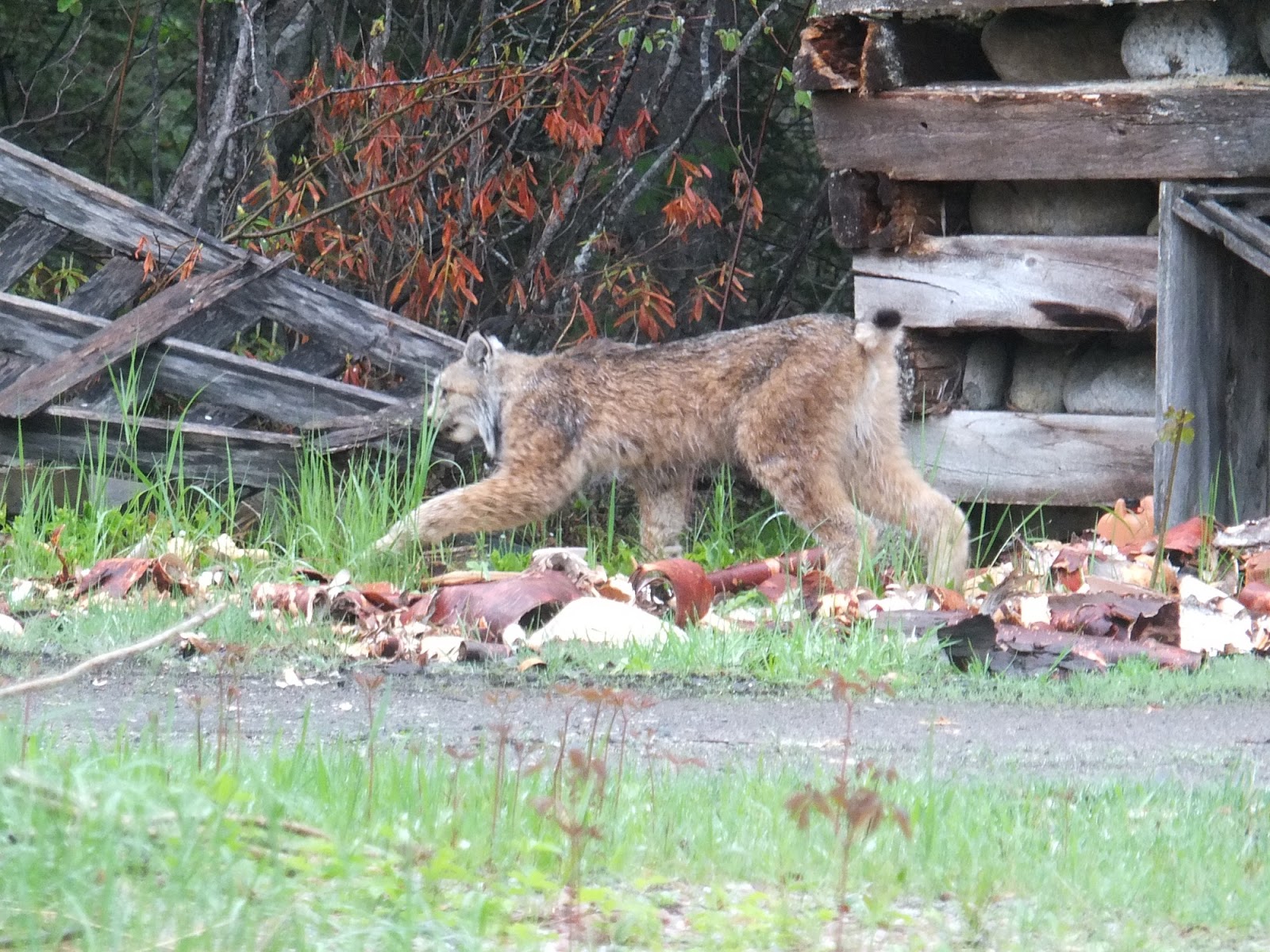
| Lynx |
 |
| Lynx |
 |
| LYNX |
 |
| Lynx |
 |
| Priceless |
All photos taken out my window ( which I washed this Spring in anticipation.)
Sunday, 25 March 2018
Tree Rings
TIMBER
Ontario
Department of Lands and Forests
Geraldton
District Weekly Report
April 20th,
1971
The Oldest
Living Things on Earth and Their Message by G. T. Marek
Some time
ago scientists found that certain species of trees showed marked variations in
the width of their annual growth rings.
Investigating this matter further they found that these variations were
related to variations in precipitation.
In a dry year a narrow annual ring of growth was formed; in an average year a ring of average width
resulted; and in a wet year the rings
were abnormally wide. By examining the
wood of representative sample trees, the year to year climate of the region
could be established as far back as the age of the oldest tree. This precipitated a great interest in very
old trees and a search began for them.
As a result the oldest living things on earth were discovered at an
elevation of 11,300 feet, namely the bristle cone pine trees (Pinus aristata) in Inyo National Forest,
California.
The age of
any tree can be established without the need for cutting it down by taking a
core sample with an increment borer.
This is a drill equipped with a hollow, tube like bit that extracts a
rod like core of wood extending from the bark to the pith. This core contains a sample of every growth
ring of the tree. After extraction the
core, which is thinner than a pencil, is examined. This can be done by naked eye or by
examination under a microscope. Working
with cores extracted from the bristle cone pines the ages of trees 4,600 years
old were discovered and a complete climatological record that extended back
more than 4,000 years was established.
In the
course of this work it was found that the same easily recognizable combinations
of wider and narrower rings occurred in many trees indicating specific climatic
cycles that took place over certain periods of time. This led to significant ring patterns and by
matching these patterns in timbers found in prehistoric Indian ruins it was
possible to extend the calendar more than 6,000 years into the past.
In this way
by decoding the information contained in wood we are able to read the message
of the trees, some of which are living and others that are dead. No one can predict what interesting facts may
be revealed through further studies of trees.
D.E. Gage,
District Forester
Friday, 23 March 2018
Logging the Nepigon.....the beginning 1910
THE NEPIGON
PULP LIMIT, 1910
General
conditions with respect to the Nepigon Pulp Limit offered for lease by tender 7th
October , 1910
The
successful tenderer shall enter into an agreement with the Government requiring
him to erect within the limits of the territory covered by the right to cut
pulpwood, or at some other place approved by the Lieutenant-Governor in
Council, a pulp and paper mill costing, with equipment thereof and machinery
contained therein, not less than five hundred thousand dollars, and will
operate the same so that the daily output thereof shall not be less than 150
tons of paper, and so that at least two hundred and fifty hands on an average
shall be kept employed in connection therein for at least ten month of each and
every year.
The said sum
of five hundred thousand dollars shall be expended as follows: - One hundred
thousand dollars during the first year, two hundred thousand dollars during the
second year, and the remainder of the said sum during the third year, it being
distinctly understood that the erection
of such mill and the employment of the hands shall form part of the
consideration for the price of the pulpwood, and that the cutting of the said
pulpwood for the use of the mill may begin as soon as and when fifty
thousand ($50,000) dollars shall have
been expended on the erection of said pulp and paper mill and equipment
thereof.
Two: The
successful tenderer to have the right to cut and remove spruce, poplar or
whitewood and banksian or jack pine, 9 inches and upwards in diameter, 2 feet
from the ground, sufficient to supply the mill or mills erected, for a period
of twenty-one years, from unoccupied, unsold and unlocated lands of the Crown,
for a distance of five miles in depth on
either side of the River Nepigon, and extending back a distance of five miles
from the shores of Lake Nepigon, subject to such reasonable terms , conditions
and regulations as to the cutting , measuring,, removing and driving of the
same as may from time to time be imposed by the Lieutenant-Governor in Council.
Three: The successful tenderer shall pay dues of 40
cents per cord for spruce and 20 cents per cord for the other woods mentioned,
or such other rates as may from time to time be fixed by Lieutenant- Governor
in Council.
Four: The
successful tenderer to get the right to cut the wood only, and not to have any
right to the soil or user thereof, except as may be necessary for cutting or
removing the wood.
Five: The
Government shall retain the right to sell, lease, locate or otherwise dispose
of any lands included in the territory on the same terms and conditions for
settlement, mining or other purposes as ordinary Crown Lands situated
elsewhere.
Six: The
successful tenderer shall not have the right to cut or remove timber of any
kind from any lands already under timber license or permit from Crown, or which
may hereafter be placed under such license or permit for the cutting of pine during the time such
license or permit is in force, or until after the pine timber has been cut
therefrom, nor shall any wood be cut in or in the immediate proximity of
territory covered with green merchantable pine available for lumbering purposes
or which may be considered by the Government to be pine bearing lands.
Seven: No
wood cut on the said territory shall be exported or sold or disposed of to any
other person or persons, but such wood shall be used for the purpose only of
supplying the said mill or mills.
Eight: The
Government will not guarantee any particular quantity of wood nor undertake to
do more than grant the right to cut such quantities of wood of the kinds
aforesaid as may be on the said property.
Nine:
Failure to erect the mill or mills and make the required expenditures within
the time specified shall entail forfeiture of the right to cut pulpwood and the
bonus paid for the same.
Ten: Proper
sworn returns of the quantity of wood cut each season shall be made to the
government in conformity with the Crown Timber Regulations and payment shall be
made for such wood not later than the first day of November in each year, and
the Government shall have all rights and powers in respect of enforcing such
payment as are now provided in the case of timber cut under timber license.
Eleven: No
refuse, saw-dust, chemicals or matter of any other kind shall be placed or
deposited in any river, stream or other waters which shall or may be injurious
to fish life.
Twelve: No
pulpwood, logs, timber or other material not in boats or scows shall be floated
or driven or allowed to be floated or driven down or to accumulate in the River
Nepigon above Camp Alexander, between the 15th days of June and
November in each and every year, and the floating or driving of pulpwood logs,
timber or other material down the said river shall be subject to further and
other regulations as may hereafter from time to time be made by the Government.
Thirteen: All Indian Reserves falling within the area
of any pulp limit are excluded therefrom.
Department
of Lands, Forests and Mines, Toronto, 8th
July, 1910
Foestry Is...
FORESTRY IS…
The Weekly
Report , District of Geraldton
Ontario
Department of Lands and Forests
October 20th,
1966
Adapted from
the
Prince George Progress.
Forestry is
the raw material of beauty, of tourism, and of industry. It is a full lunch bucket and coins jingling
in pockets.
Forestry is
tree growing and tree managing. Forestry in Canada is 5 billion dollars a year.
(1966)
Yes,
forestry is many things.
It is the
whine of a powersaw and the moment of suspense when a faller’s tree hangs
between heaven and earth. It is a “cat”
carving a trail to a new stand of timber and a drawing board where a bridge is
designed.
It is 30 tons of logs piled on a growling truck, and
dollar-earning newsprint spinning off the rollers at half a mile a minute.
Forestry is
the patient probing of the secrets of genetics and a quest for bigger, better,
faster growing trees. It is 60 million
seedlings a year in Ontario hand planted on thousands of acres of logged-off
land. It is a ranger patrolling timber
from a river boat and a sweat backed
stevedore loading lumber on a foreign ship.
Forestry is
still flapjacks and bacon and eggs fried potatoes for breakfast, but it is
mechanical harvesters that have made horses almost extinct in the woods. It is a spreading population of deer and
moose and a vast province being gradually opened for the traveller’s
delight. It is tree pruning, and
sod-busting and fat cattle grazing within smelling distance of a slash burn.
It is
stereoscopics and data-processing machines and a hand-axe and a back-packed
water pump trekked over a hill.
Forestry is
scarlet flames roaring through a fir stand, and infestation of budworm, but it
is wind whispering through a pine grove and s singing trout stream and deer
feasting with pleasant malevolence on tender young trees.
In spring it
is greenery and growth and awakening; in
autumn it is a surrealistic masterpiece in green and gold and yellow painted by
the greatest Master of them all.
Forestry is the life blood of our economy.
G.E.
MacKinnon, District Forester
Subscribe to:
Posts (Atom)