Saturday, 20 October 2012

A LESSON IN FIREWOOD


Birch Family: Betulaceae
Family members: Birches, Alders, Hornbeams, Hophornbeams, Hazelnut.

Flowers in Catkins

Fruit in Nutlets or nuts


Genus: Betula
Birches
 Genus = 40 species (trees and shrubs)

Of the seven tree species 3 are important.


Betula papyrifera
Paper Birch

Paper Birch Common names: Canoe Birch, Silver Birch, White Birch

Paper Birch Range: Trans-continental almost to the northern timberline.

Paper Birch is a cold climate species, found at all elevations in their northern range.

Survives under varied precipitation.

Likes dry sites on glacial tills -  but in Northern Minn. they thrive in the poorly drained soil.

The Operator

The Company They (the paper Birch) Keep
  • Jack Pine
  • Aspen/Poplar
  • Balsam Fir
  • White Spruce
  • Black Spruce


The Life of Betula papyrifera:

Seed dispersal by wind begins about age 15 during August into September.  Seed production peeks from age 40 to age 70 years..

A study done in the state of Mass. U.S.A. in 1955 counted 36 million seed per acre. They were using one-chain wide strips cut in the 70 year old birch stand.  From that , 36,000 seedlings per acre, became established, growing three to four inches the first year. Compare this to sprouts that grow up to 2 feet the first year. But sprouts have a high mortality rate.

Seed Size ? 1.5 million to the pound.


Diameter growth hinges more on temperature changes than rainfall.
Paper Birch can be propagated by cuttings treated with a growth promoter.

These trees mature at 60 to 70 years - that makes them a short lived species?
Some reach 140 years and a few go over the 200 year life.

50.2 cm.
On the OMNR Web Site - Ontario's Tree Atlas - White Birch - the oldest white birch tree in Ontario is recorded in Rainbow Falls Provincial Park as a living , 240 year old birch with a possible diameter of 35 cm.  As you can see this birch log in our firewood pile has a Red-Heart stain of 25 cm in a maybe not-so-round diameter of 50.2 cm. I don't think they really looked that hard for a big birch.


The truck bed is swept of debris.
A good stand of birch can run 31 cords to the acre in 50 years.
From LOG BOOK January 1950 page 4

"Woods Used in Northwestern Ontario Pulp and Paper Industry"
By : Alex Johnson, Pulp Mill Superintendent, Provincial Paper Mill,
Port Arthur, Ontario

"Pulp making separates the tree fibres so they can be reformed into a sheet of paper."

Birch was not used extensively in the past (before 1950) but now more and more is being used for that.

There is a large quantity of it available (1950).

It can be peeled by hand (springtime) or in the drum barkers.

It being a heavier wood = great yield per cord. Oven dry weight = 31 pounds per cubic foot being one third heavier than poplar.
Fibre length = 1.2mm  20% greater than poplar and half as long as spruce. This makes birch "one of the more desirable hardwoods for pulpmaking."

All set to go home.
SUFFERING BIRCH

Paper Birch need 'space" to grow and suffer from competition, however 'thinning' doesn't seem to help birch put on growth rate as that process does other species. In natural succession it usually is replaced after one generation by another species. It's part of our "climax" forest of White Spruce and Balsam Fir.

POST LOGGING DECADENCE

When stands are opened up they develop lowered vigor, reduced growth, dying back of twigs and branches followed usually by the death of the tree. (One sees this happen all the time as new country homes landscape to keep their beautiful birch only to have them die within a few years.)
BIRCH DIE BACK

"What's wrong with your birch?"
A visitor to the Nipigon Museum (from Virginia) asked.

Birch die back has nearly the same symptoms as logging decadence .
The tree seems to die from the top down.
However, it can occur in undisturbed stands - so declaring the Boreal Forest off-limits to Industrial activity wouldn't save them.

In the 1930's and 40's an outbreak of birch die back in Eastern Canada and Maine took down almost 70% of the birch trees by 1951.

NO KNOWN DEFINITE CAUSE HAS BEEN IDENTIFIED TO DATE.

While checking out the Internet I found reference to an article "Potential Role of Calcium...reversing die back, but I couldn't get the Site to open. I really wanted that one because when we were mixing cement for our house foundation in 1975, we did it next to a birch clump with die back advancing on the main stem. Lots of 'cement water" flowed around the mixer every day we rinsed it out. The next year that tree took on new life and never looked back. A few years later it did get Bronze birch borer but continued to grow even with its speckled leaves until we had a winter of minus 30 to 40 degrees in January and February - that was the end of the borer and the tree had healthy green leaves from then on.

ROOTLET MORTALITY

Similar symptom to die back ( I can attest to this as I accidentally chopped off a root of the above Birch clump - like twenty feet away from its base. One can't stick a root back together. So I watched as the next few years, one stem lost first one limb and then another until we had to cut that stem off for safety reasons.)  Rootlet mortality can come from increased soil temperature - so now we add Climate Change into the mix.

FIRE

Fire is both a killer and a regenerator as it opens areas for airborne seeds to land and germinate.

ANIMALS

Mice, voles, chipmunks, squirrels, rabbits, Porcupine, beaver, deer, moose

SONGBIRDS (not really destructive)

Black capped Chickadee, purple Finch, Common Red poll, Yellow bellied Sapsucker, Pine Sisken, Fox Sparrow, Tree Sparrow, Ruffed Grouse, Spruce Hen, Sharp tailed Grouse.

INSECTS

Luna Moth caterpillar food. Gypsy Moth and the Forest Tent Caterpillar Malucasoma disstria, or as we like to call them Army Worms - march, munch or die. After three years of continued attacks growth falls 86%.

Bronze Birch Borer Agrilis anxius, comes right along after die back or logging decadence sets in - its an insect that infests weakened trees. Not the cause of die back it may aid in the tree's death.

MAN

Besides the obvious tree cutting - stripping the bark from live trees will kill it.

Red Heart is a reddish-brown discolouration.
 This defect limits the use of Paper Birch for  speciality products.
It's wetter and more extensive than heartwood.
Cause believed to be a parasite.
John McLaughlin, OMNR, OFRI, - "White Birch is one of the least defective species averaging less than 5% of 100 year old merchantable volume."

Red Heart is a stain from reaction to enzymes released by non-decay fungi coming in through wounds.

Those of you who followed Walt Kelly's "Pogo" in the 1950's, may remember Albert, the Alligator's impersonation of a dog:

"Birch! Birch!" said Albert, it was the only bark he knew.

A lot of this information comes from 'Silvics of Forest Trees of the United States Agriculture Handbook, No. 271"  Forest Service 1965  U.S. Dept. pf Agriculture, Washington D.C. 20250  Pages 93 to 97.
Prepared by the Division of Timber Management Research, Forest Service
Complied and revised by H.A. Fowells, Chief, Branch of Silviculture
Completed by Carl E. Ostrom
Started in 1955 by Division Director F.H. Eyre from information supplied by 10 regional Forest Experiment Stations equalling 127 reports.
Range maps by E. L. Little, Jr. , Forest Service Dendrologist.


Friday, 19 October 2012

THE NEW DICTATORS

A new book just out written by Elizabeth Nickson titled "Eco - Fascists"

'How Radical Conservationists are Destroying our Natural Heritage"

Published by Broadside Books  an Imprint of Harper-Collins Publishers

ISBN: 978-0-06-208003-5

As part of her investigations she tracks a lot of "results" of the loss of WATER RIGHTS in the U.S. western states.
Remember PEW and their FOREST OF BLUE?  maybe we can be prepared if we read this book by Elizabeth and recognize the symptoms before our rights are stripped from us.

I got my copy from Amazon Books.

Wednesday, 10 October 2012

MAYBE I SHOULD TAKE UP SMOKING, just to be safe in the bush

ALBERT SIDEEN tells this tale in LOG BOOK , January 1950

Down at the Black Sturgeon some years ago during a bad fire, Albert was down checking fire pumps, and Dave Graham, who was walking boss at the Sturgeon, used to drop over frequently to see the equipment was O.K.

 This day, Albert was sitting on a log when he heard footsteps behind him. Thinking it was Dave, Albert, who was smoking his corn cob pipe, moved over on the log to make room for Dave to sit down. Nobody came but Albert could feel something licking  the back of his neck, so he turned around to investigate.  All he could see was a pair of cold beady eyes and then he distinguished behind the eyes a large black bear. 

Albert had left his axe in a log about 15 feet away and had no other weapon or means of defence with him. True to the bush tradition, to make use of anything at hand, Albert drew deeply on the corn cob pipe and blew a super smoke ring. As the ring settled firmly around the bear's jaws, holding them firmly shut, Albert secured the axe and polished off Mr. Bruin.

 Albert is not too sure tobacco is as strong today as it used to be, so doesn't advocate this means of defence, except as a last resort.

LOG BOOK  was a Thunder Bay Timber Operators Association magazine
The magazine was printed on "Thrift-Coat Enamel" produced at the Provincial Paper Limited, Port Arthur Mill, Ontario, out of wood produced in Northwestern Ontario and printed by the Consolidated Press, 137 South May Street, Fort William, Ontario   1950.

Saturday, 6 October 2012

THE COLOURS WERE BEAUTIFUL, and then

The First Week of October 2012

Poplar and willow, spruce and Jack Pine.
Centre tree is the Winter Burn Spruce across our garden.

The black of the spruces set off the yellow poplars.

Blue skies work as a background too.

The short stuff is where the bright colours are found.

A sunny morning helps.

Red Osier Dogwood lives up to its name.

Really short stuff.

This was the Pin Cherry on Thursday.

This is the Pin Cherry this morning, Saturday Oct. 6, 2012.

Tuesday, 18 September 2012

SHARP-SHINNED HAWK

THE FEEDER WATCHER

September 18, 2012

Watching our bird feeder.

The Red Squirrel had been giving it a hard time.
Scolding from about a foot and a half away.

The Junco, White throated Sparrow, Goldfinches
and Brewer's Blackbird took off and hid.
The Black-capped Chickadee kept coming and going.
The Blue Jays came right into its perch tree.

It was waiting for the Evening Grosbeaks.

Wednesday, 12 September 2012

SOMETHING FOR NOTHING ?

NO WAY!

Let us look at the General Conditions with respect to The Nepigon Pulp Limit offered for lease by Tender : 7th October, 1910

CONDITIONS WITH RESPECT TO THE NEPIGON PULP LIMIT

The successful tenderer shall enter into an agreement with the Government requiring him to construct within the limits of the territory covered by the right to cut pulpwood, or at some other place approved by the Lieutenant-Governor in Council, a pulp and paper mill costing, with equipment thereof and machinery contained therein, not less than five hundred thousand dollars, and will operate the same so that the daily output thereof shall not be less than 150 tons of paper, and so that at least two hundred and fifty hands on an average shall be kept employed in connection therewith for at least ten months of each and every year.

The said sum of five hundred thousand dollars shall be expended as follows: - One hundred thousand dollars during the first year, two hundred thousand dollars during the second year, and the remainder of the said sum during the third year, it being distinctly understood that the erection of such mill and the employment of the hands aforesaid shall form part of the consideration for the price of the pulpwood, and that the cutting of the said pulpwood for the use of the mill may begin as soon as and when fifty thousand dollars shall have been expended on the erection of the said pulp and paper mill and equipment thereof.

2. The successful tenderer to have the right to cut and remove spruce, poplar or whitewood and banksian, or jack pine, 9 inches and upwards in diameter, 2 feet from the ground, sufficient to supply the mill or mills erected, for a period of twenty-one years, from unoccupied, unsold and unlocated lands of the Crown, for a distance of five miles in depth on either side of the River Nepigon and extending back a distance of five miles from the shores of Lake Nepigon, subject to such reasonable terms, conditions and regulations as to the cutting , measuring, removing and driving of the same as may from time to time be imposed  by the Governor in Council.

3. The successful tenderer shall pay dues of 40 cents per cord for spruce and 20 cents per cord for the other woods mentioned, or such other rates as may from time to time be fixed by the Governor in Council.

4. The successful tenderer to get the right to cut the wood only, and not to have any right to the soil or user thereof, except as may be necessary for the cutting and removing the wood.

5. The governor shall retain the right to sell, lease, locate or otherwise dispose of any lands included in the territory on the same terms and conditions for settlement, mining or other purposes as ordinary Crown lands situated elsewhere.

6. The successful tenderer shall not have the right to cut or remove timber of any kind from any lands already under timber ;license or permit from the Crown, or which may hereafter be placed under such license or permit for the cutting of pine during the time such license or permit is in force, or until after the pine timber has been cut therefrom, nor shall any wood be cut in or in the immediate proximity of territory covered with green merchantable pine available for lumbering purposes or which may be considered by the Government to be pine-bearing lands.

7. No wood cut on the said territory shall be exported or sold or disposed of to any other persons, but such wood shall be used for the purpose only of supplying the said mill or mills.

8. The Governor will not guarantee any particular quantity of wood nor undertake to do more than grant the right to cut such quantities of wood of the kinds aforesaid as may be on the said property.

9. Failure to erect the mill or mills and make the required expenditures within the time specified shall entail  forfeiture of the right to cut pulpwood and the bonus paid for the same.

10. Proper sworn returns for the quantity of wood cut each season shall be made to the Government in conformity with the Crown Timber Regulations, and payment shall be made for such wood not later than the first day of November in each year, and the Government shall have all the rights and powers in respect of enforcing such payments as are now provided in the case of timber cut under timber license.

11.No refuse, saw-dust, chemicals or matter of any other kind shall be placed or deposited in any river, stream or other waters which shall or may be injurious to fish life.

12.  No pulpwood, logs, timber or other material not in boats or scows shall be floated or driven or allowed to be floated or driven down or to accumulate in the River Nepigon above Camp Alexander, between the 15th days of June and November in each and every year, and the floating or driving of pulpwood, logs, timber or other material down the said river shall be subject to such further and other regulations as may hereafter from time to time be made by the Government.

13. All Indian Reserves falling within the area of any pulp limit are excluded therefrom.

DEPARTMENT OF LANDS, FORESTS AND MINES, TORONTO, 8TH JULY, 1910 (Nipigon Historical Museum Archives)

After note, September 12, 2012 : in the 1990's we thought ZERO DISCHARGE was something new, but reading # 11 we see that right from square one it was a "condition" for the pulp and paper industry of Ontario.  Now, whether it remained a condition after the  21 years ??

THE GROUSE AMONG US

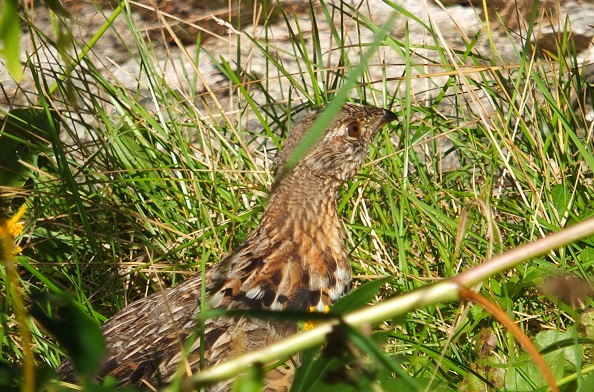
RUFFED GROUSE GROWING UP

Their tails are not yet full grown as of September 11.

They usually keep an eye on you, but go about their business.


Growing up in Southern Ontario
 it was a marvel if one could get within forty feet of a grouse.

We don't hunt partridge since we moved to Nipigon.
 We tried it in 1966 but when the hunter has to BACK UP  in order to get a shot,
 there is no "sport" in that. 


They like dandelion leaves or plantain.

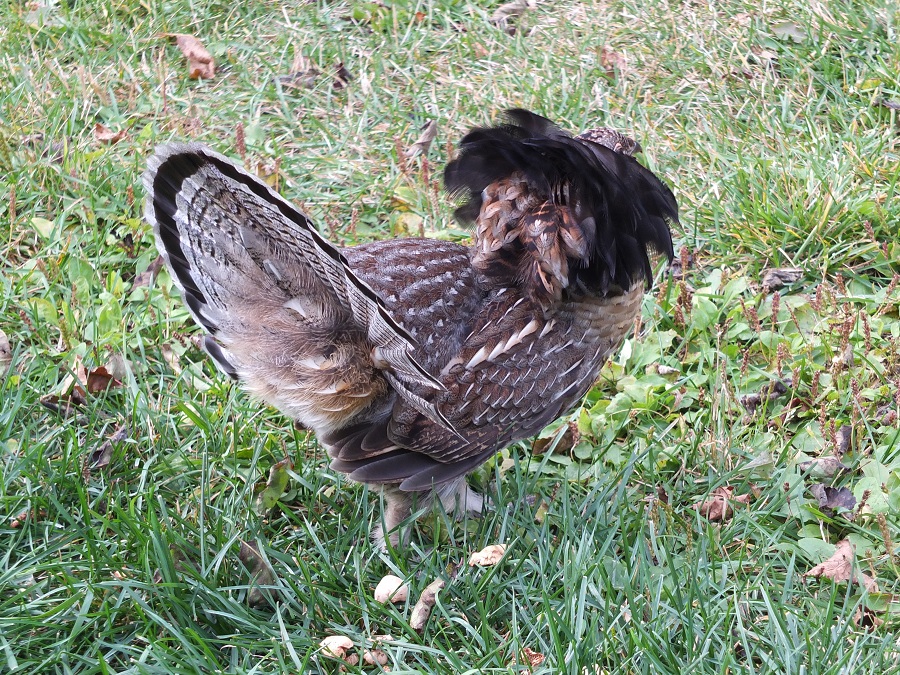
This is their " Father", September 13, 2012.

September 28, 2012
Bottoms Up

He has his eye on a hen under the tree.

Now he has his eye on me but I don't count.
Sept 28, 2012 Not distracted one bit.